

Overview Legend 🧭
Overview Legend 🧭
Introduction
DATEV is German accounting software used by tax advisors and their clients. The connector reaches DATEV Rechnungswesen, its on-premise accounting system, and optionally DATEV Unternehmen online for attachments. When the DATEVconnect API URL cannot be exposed externally, Chift connects instead through a local agent on the DATEV server.Activate DATEV
Partner keys
Partner keys are only used to send attachments to DATEV Unternehmen online, through DATEV’s accounting:documents API. Without attachments, no keys are involved. DATEVconnect itself, which reaches DATEV Rechnungswesen, authenticates with the end user’s Windows account instead of an OAuth2 app.Use Chift's app
Ask your Chift point of contact. No developer account needed.
Use your own app
Register your own OAuth2 application on the DATEV Developer Portal for the accounting:documents API. It requires being a DATEV business partner (Geschäftspartner) and passing a technical review by DATEV before going to production.
1
Sign in or sign up
Sign in with a DATEV account, or create one.
2
Join or create an organization
This requires being a DATEV business partner (Geschäftspartner). Enter your consultant number, or a partner organization is created for you.
3
Create the app
Create an app on the portal and retrieve its Client ID and Client Secret.
4
Subscribe to accounting:documents and develop against the sandbox
Every app created on the portal comes with a sandbox for the accounting:documents API.
5
Configure the redirect URI and scopes
Set the redirect URI to:Request these scopes:Chift adds a client-specific scope automatically when an end user connects.
6
Request production access
Submit the app for DATEV’s technical review by the DATEV Consulting Ecosystem. Approval is required before end users can connect.Onboarding costs EUR 1,500, with 4 hours of consulting included, then EUR 210 per hour.
Activate DATEV in your Chift account
In Connectors, enter your Client Id and Client Secret.
Connector settings
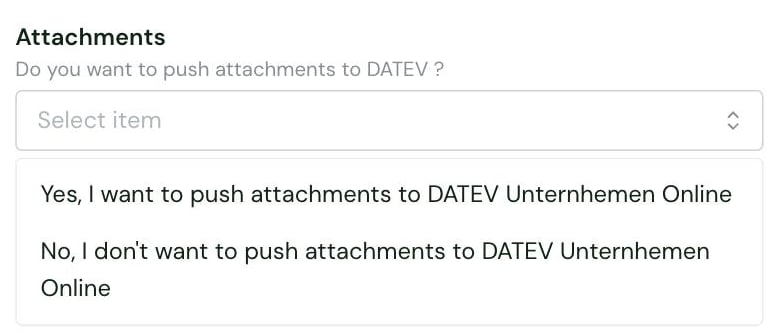
- Yes, I want to push attachments to DATEV Unternhemen Online (default): attachments are sent.
- No, I don’t want to push attachments to DATEV Unternhemen Online: no attachments are sent.
- With the public URL method, end users enter a consultant number and client number only when Attachments is on.
- In that case, their company is deduced from the client number instead of chosen.
- With the local agent, both numbers are always requested, whatever the Attachments setting.
Test DATEV
Vendor fees
Software editor (you)
A paid DATEV test system, for the DATEV and DATEV (LocalAgent) connectors. See Test DATEV for where to get one.Registering your own app for attachments adds a EUR 1,500 onboarding fee, with 4 hours of consulting included, then EUR 210 per hour. See DATEV’s developer FAQ.
End user
No fees beyond their DATEV licences. Sending attachments requires a paid DATEV Unternehmen online subscription.
Connect DATEV
DATEV setup guide for end users
Connect using the public DATEVconnect API URL.
DATEV local agent guide for end users
Connect using a local agent installed on the DATEV server, when the URL cannot be exposed.
- a DATEV Rechnungswesen licence, held directly or through their accountant or tax advisor
- a DATEVconnect licence, usually already included and free to order from DATEV’s shop if missing
- a Windows user account linked to their DATEV user, with access to the relevant company and rights to use DATEVconnect
- for the public URL method, their DATEV IT provider or integrator to expose the DATEVconnect API URL externally, directly or through the Riecken Cloud Gateway
- to send attachments: a DATEV Unternehmen Online (DUO) licence, DATEV SmartLogin (free), and the DATEV Belegbilderservice Rechnungswesen active for their DATEV client
- with the public URL method, enter the DATEVconnect API URL
- with the local agent method, install the agent on the server running DATEV instead
- enter the Windows username and password linked to their DATEV account, and authorize the connection
- with the Riecken Cloud Gateway, enter the Client Id and Client Secret Riecken provided instead of the Windows credentials
- if Attachments was not already fixed at connector level and a Client Id is configured, choose whether to send attachments to DATEV Unternehmen online
- if sending attachments, sign in to DATEV with SmartLogin, SmartCard or mIDentity, and approve access
- if sending attachments with the public URL method, enter their consultant number and client number; their company is deduced from it
- with the local agent, always enter both numbers
- if not sending attachments with the public URL method, select their company after signing in; the local agent has no company choice
Rate limits
No rate limit documented by DATEV.Limitations & specificities
Chart of accounts & VAT
Chart of accounts & VAT
Ledger accounts with VAT rates configured in DATEV only accept entry lines that carry a VAT code, at one of the rates the account allows. The VAT code goes in
tax_info.The tax amount must match the VAT code’s rate.Attachments
Attachments
Attachments go only to DATEV Belege online, when an invoice or journal entry is created and Attachments is on. Each file is 20 MB maximum, and a multi-page document must be sent as a single file.
Closure
Closure
An entry in a locked fiscal year is rejected.
Multi-folder
Multi-folder
Not supported: each connection maps to a single DATEV client.