

Overview Legend 🧭
Overview Legend 🧭
Introduction
Dinero is a Danish cloud accounting and invoicing software developed by Visma. It is popular with small and medium-sized Danish businesses for its modern interface and open API, and covers invoicing, bookkeeping and VAT reporting.Dinero organizes each company’s data under an organization. One Chift connection maps to one Dinero organization.
Configure Dinero
Prerequisites
To activate the Dinero connector, you need an OAuth2 app registered with Dinero (via Visma Connect). You have two options:Use the Chift OAuth2 app
Reach out to your Chift point of contact. They will provide the
client_id and client_secret of Chift’s Dinero app and configure them on your Chift platform.No additional requirement — the fastest way to go live.Create your own OAuth2 app
Register your own app on the Visma Developer Portal and get it approved by Dinero.Requires a Visma Developer account, a
web application in Visma Connect with the right scopes and redirect URI, and a technical review by Dinero.Activation process
The steps below apply if you chose to create your own OAuth2 app. If you use the Chift OAuth2 app, your point of contact handles the setup for you — skip straight to Test Dinero.1
Create your Visma Developer account
Sign up on the Visma Developer Portal. Set your team’s country to Denmark and use your real CVR number, otherwise your application will be rejected.
2
Add a web application in Visma Connect
From My Applications, click Add Application and choose Web application (Dinero’s only supported client type). Pick a
Name and Client ID that clearly identify your company (e.g. isv_yourcompany); generic names like isv_test are rejected. Do not include “Dinero” in the name.3
Configure grants, scopes and redirect URI
Use the
Authorization Code grant with offline access enabled (re-use refresh token, 365 days expiration is recommended). Request the scopes dineropublicapi:read, dineropublicapi:write and offline_access. Set the redirect URI to:4
Pass Dinero's technical review
Thoroughly test your app, then submit it for review. Dinero verifies your scope usage and example calls before granting production access. See the Dinero Getting Started guide for the full flow.
5
Activate the connector on Chift
In your Chift back office, open the Dinero connector and paste your Client ID and Client Secret. End users are then redirected to Visma Connect to authorize access.
Test Dinero
Go to dinero.dk and click “Opret gratis test konto” (“Create free test account”) to create a test account. The trial is valid for one month.Connect Dinero
To activate a connection with Dinero, end users go through the following steps:- English article: Help Center - Dinero EN
Pricing
End users need a Pro plan subscription (the Total plan also works) to use the Dinero API: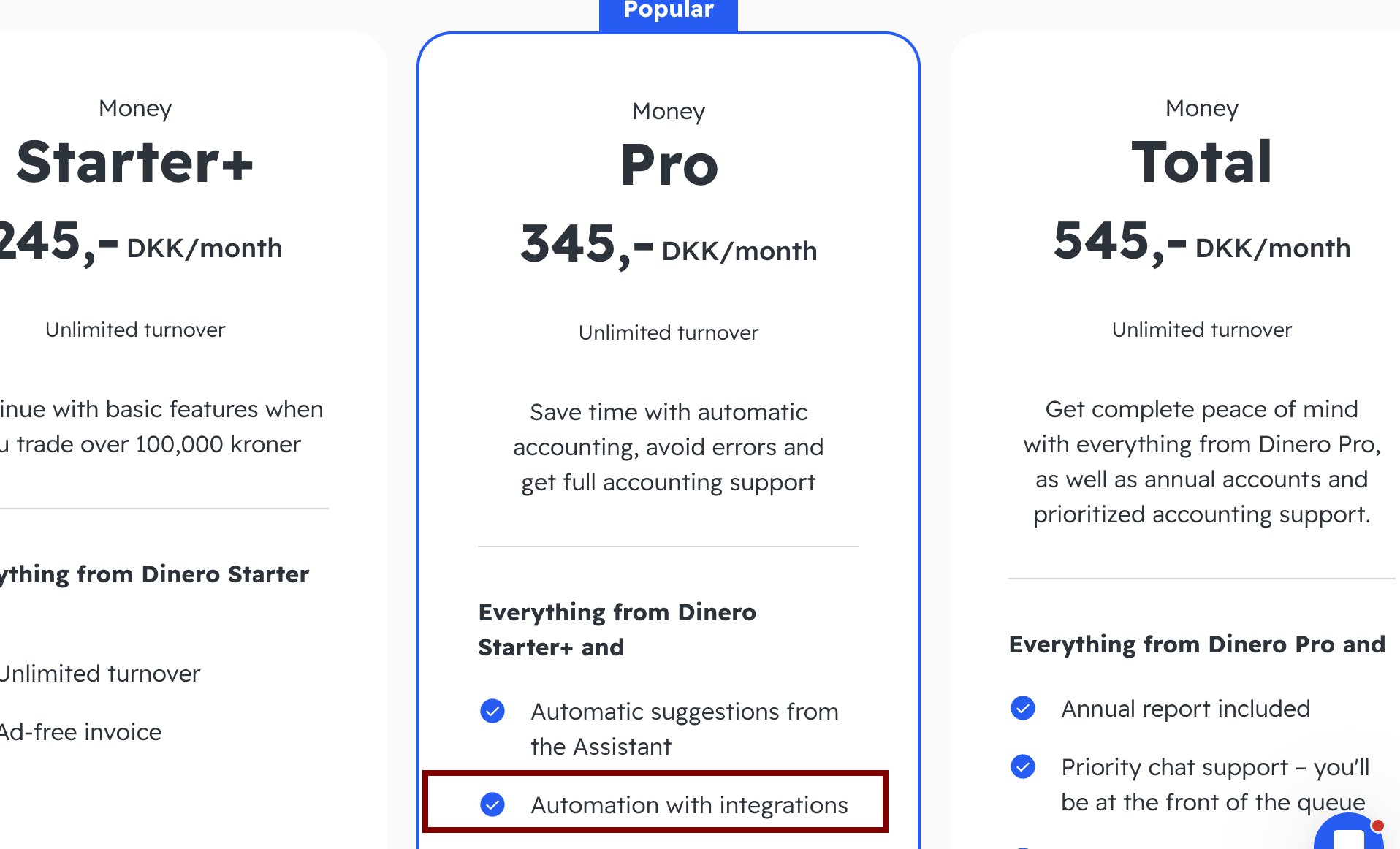
Rate limits
Dinero allows 100 calls per minute per organization.Technical limitations & specificities
Bank feed
Dinero does not support a bank feed through Chift — Dinero only integrates directly with banks itself.Contacts model
GET customers and GET suppliers both read from Dinero’s single contacts list — Dinero has no dedicated customer or supplier object. As a result, every contact is returned regardless of whether it’s used as a customer or a supplier.
Chart of accounts & VAT codes
Dinero requires avat_code on every account that generates VAT (sales or expense accounts). When you create chart-of-accounts entries via Chift, you need to set a vat_code if this is relevant (sales/purchase accounts).
Invoices by type
GET invoices by type does not return supplier_invoice or supplier_refund — these are only available through the journal entries object.
Creating sale & purchase entries
invoice_numbercan only be set on posted documents — draft invoices have noinvoice_number.- No exchange rate can be forced: Dinero always applies the day’s exchange rate for the invoice currency.
- Dinero derives the
tax_codeand rate from theaccount_numberand calculatestax_amountitself. - Credit notes and refunds have no due date.
financial_periodcannot be used as a query parameter.
Journal entries
- No native filter on
journal_id. - Dinero has no concept of “unposted” journal entries.
date_fromanddate_toare both required when listing journal entries.updated_aftercannot filter more than 1 month back.- Amounts are always returned in the organization’s currency (DKK), even when the underlying invoice or payment is in a foreign currency.
POSTjournal entries and financial entries only accept amounts in the organization’s currency (DKK).