> ## Documentation Index
> Fetch the complete documentation index at: https://docs.chift.eu/llms.txt
> Use this file to discover all available pages before exploring further.
# Building with Syncs
In the Sync model, **Chift builds the integration and triggers the flows**. You do not read or write the end-user's data yourself. You delegate the synchronisation to Chift. Chift defines the sync with you. Chift then runs it on an event or a schedule. You write no integration code.
New to the terms *connector*, *consumer*, and *connection*? Read [How it works](/guides/how-it-works) first.
 ## How a sync works
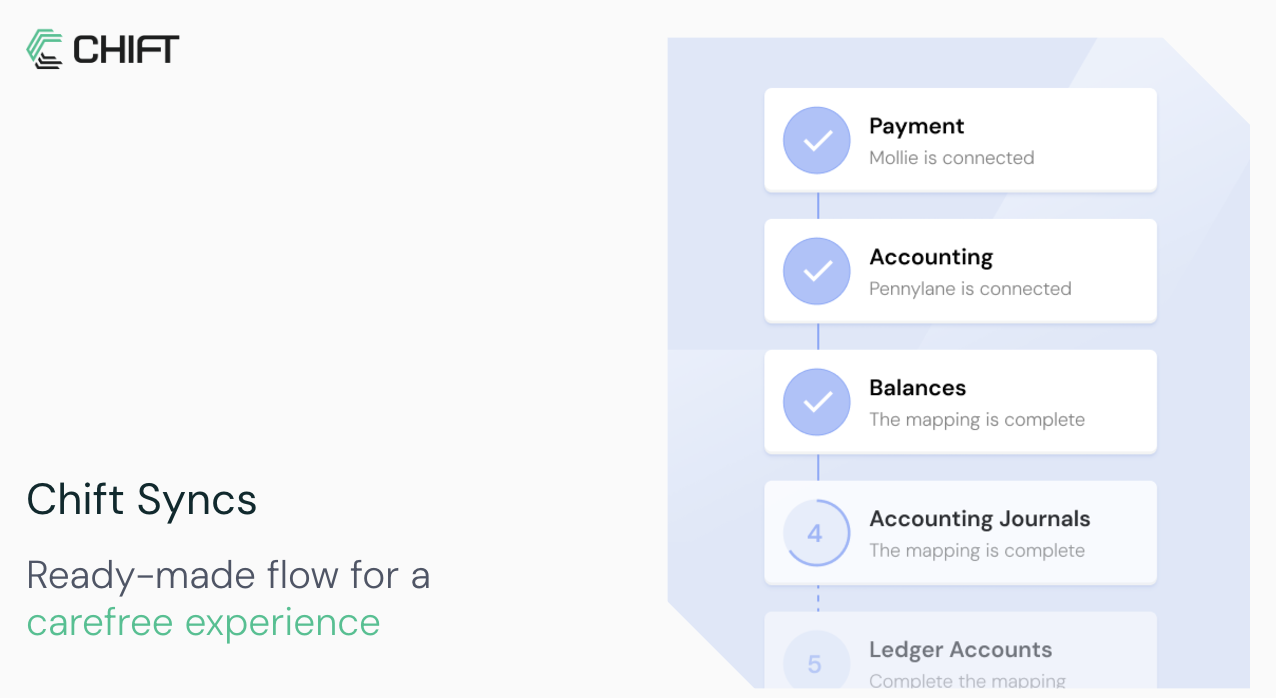
A **sync** is a synchronisation between two of Chift's APIs. Chift builds and maintains it. A sync contains one or more **flows**. An event or a timer triggers each flow, for example every night at 4 AM. Each flow runs a process for every consumer linked to the sync, such as *get invoices and inject them into accounting*.
A sync can include **mappings**. A mapping is a correspondence your end-user fills during onboarding. For example, the end-user matches tax rates between their POS and their accounting software.
## Who does what
* **You** create the consumer, create the sync activation link, and redirect your end-user to it. You can also read the sync status and trigger runs from your backend.
* **Your end-user** opens the link and connects their own software on a Chift-hosted page. The end-user then confirms the mappings the flow needs. The other side of the sync is your software, fixed for all your end-users.
* **Chift** builds the flows, stores and refreshes the credentials, and runs each flow on its trigger for every linked consumer.
## What you store
Store the **`consumerid`** on your end-user record. Pass it to every sync call for that end-user. You also need the **`syncid`** of the sync Chift built for you. Get it from [Get syncs](/api-reference/endpoints/syncs/get-syncs).
## The build path
Chift builds the sync and its flows with you. Chift also defines the triggers. [Contact us](https://www.chift.eu/contact) to scope a sync for your use case.
Exchange your API key for a bearer token. See [Authenticate with Chift API](/guides/chift-authentication).
Create a consumer, create the sync activation link, and redirect your end-user to it. See [Activating a sync](/guides/syncs/how-to-activate).
Confirm the setup is complete. Then monitor the executions. See [Monitor sync executions](/guides/syncs/monitor-executions).
## In this section
The full flow, from creating a consumer to the Chift-hosted sync page.
The sync activation link, connector pre-selection, and the redirect afterwards.
Confirm setup, list executions, read statuses, and trigger a run.
## Learn more
The Syncs product documentation describes building syncs, exposing them to end-users, and the ready-to-use syncs:
Requirements, how Chift builds a sync with you, and the dedicated endpoints.
The full Syncs section, including ready-to-use syncs.
Chift builds each sync with you. [Contact us](https://www.chift.eu/contact) to scope a sync for your use case.
## How a sync works
A **sync** is a synchronisation between two of Chift's APIs. Chift builds and maintains it. A sync contains one or more **flows**. An event or a timer triggers each flow, for example every night at 4 AM. Each flow runs a process for every consumer linked to the sync, such as *get invoices and inject them into accounting*.
A sync can include **mappings**. A mapping is a correspondence your end-user fills during onboarding. For example, the end-user matches tax rates between their POS and their accounting software.
## Who does what
* **You** create the consumer, create the sync activation link, and redirect your end-user to it. You can also read the sync status and trigger runs from your backend.
* **Your end-user** opens the link and connects their own software on a Chift-hosted page. The end-user then confirms the mappings the flow needs. The other side of the sync is your software, fixed for all your end-users.
* **Chift** builds the flows, stores and refreshes the credentials, and runs each flow on its trigger for every linked consumer.
## What you store
Store the **`consumerid`** on your end-user record. Pass it to every sync call for that end-user. You also need the **`syncid`** of the sync Chift built for you. Get it from [Get syncs](/api-reference/endpoints/syncs/get-syncs).
## The build path
Chift builds the sync and its flows with you. Chift also defines the triggers. [Contact us](https://www.chift.eu/contact) to scope a sync for your use case.
Exchange your API key for a bearer token. See [Authenticate with Chift API](/guides/chift-authentication).
Create a consumer, create the sync activation link, and redirect your end-user to it. See [Activating a sync](/guides/syncs/how-to-activate).
Confirm the setup is complete. Then monitor the executions. See [Monitor sync executions](/guides/syncs/monitor-executions).
## In this section
The full flow, from creating a consumer to the Chift-hosted sync page.
The sync activation link, connector pre-selection, and the redirect afterwards.
Confirm setup, list executions, read statuses, and trigger a run.
## Learn more
The Syncs product documentation describes building syncs, exposing them to end-users, and the ready-to-use syncs:
Requirements, how Chift builds a sync with you, and the dedicated endpoints.
The full Syncs section, including ready-to-use syncs.
Chift builds each sync with you. [Contact us](https://www.chift.eu/contact) to scope a sync for your use case.